
Why Smart Home Automation Has Become Standard in South Africa’s R10m-Plus Homes
For most of the past decade, smart home automation in South Africa sold itself for the wrong reason.
Load shedding did the work. A homeowner in Constantia or Bantry Bay would phone after a bad Stage 6 week, ask about an inverter, and by the end of the conversation the lighting, the gate, the cameras and the irrigation had all been folded into one system. The blackout was the pitch. The automation was the upsell.
That pitch has expired. On 16 May 2026, Eskom passed 365 consecutive days without load shedding, the first clear year since September 2018. The lights stay on. The generator in the side passage has become an expensive ornament.
And yet the briefs coming across our desk for homes above R10 million have not slowed down. They have got longer, more detailed, and far more likely to arrive from an architect at concept stage than from a panicked owner in week three of a blackout cycle. Which tells us something useful: the load shedding argument was never really the argument.
The grid stabilised. The bill did not.
Stable electricity is not cheap electricity. NERSA approved an average 8.76% increase for Eskom’s direct customers from 1 April 2026, with municipal customers absorbing roughly 9.01% from 1 July. A further 8.83% has already been signed off for 2027/28. Compound those and you are looking at a tariff that roughly doubles inside a decade.
For a 200m² townhouse this is annoying. For a 700m² home in Steenberg or Somerset West with a pool, a borehole pump, underfloor heating across two floors, a wine cellar, three HVAC zones and a gate motor that cycles forty times a day, it is a line item that quietly runs to five figures a month.
Here is the part most homeowners discover too late: solar alone does not fix this. A 20kW array and a bank of batteries will happily power a heat pump that has been running since 4am for no reason. Panels generate. They do not decide. The decision layer — knowing that the pool pump should run at midday against the solar peak rather than at 7pm against the grid, that the underfloor heating in the guest wing should not come on when nobody has slept there since April — is the automation.
That is the shift. Automation used to be about surviving the grid. It is now about not being financially punished by it.
A big house has a load profile, not a light switch
There is a second, quieter reason automation has stopped being optional at this level, and it is architectural rather than economic.
Look at what R10m-plus buys in the Western Cape right now. Double-volume glazing. Long uninterrupted sightlines. Flush plaster ceilings with no cornices to hide anything in. Kitchens that flow into dining rooms that flow onto terraces, with no doors and no obvious point at which one room ends.
Now try to light that conventionally. A single open-plan living space in a home like this may carry thirty-plus light fittings across six or seven circuits: feature pendants, cove strips, downlights over the island, exterior wash on the boundary wall so the garden does not become a black mirror at night. Wire that the traditional way and you get a bank of fourteen switches next to the passage door, which is precisely the thing the architect spent eighteen months designing out.
Nobody learns fourteen switches. They find the three they can tolerate and leave the rest permanently on or permanently off. The lighting design that cost R400,000 gets used at about 20% of its intent.
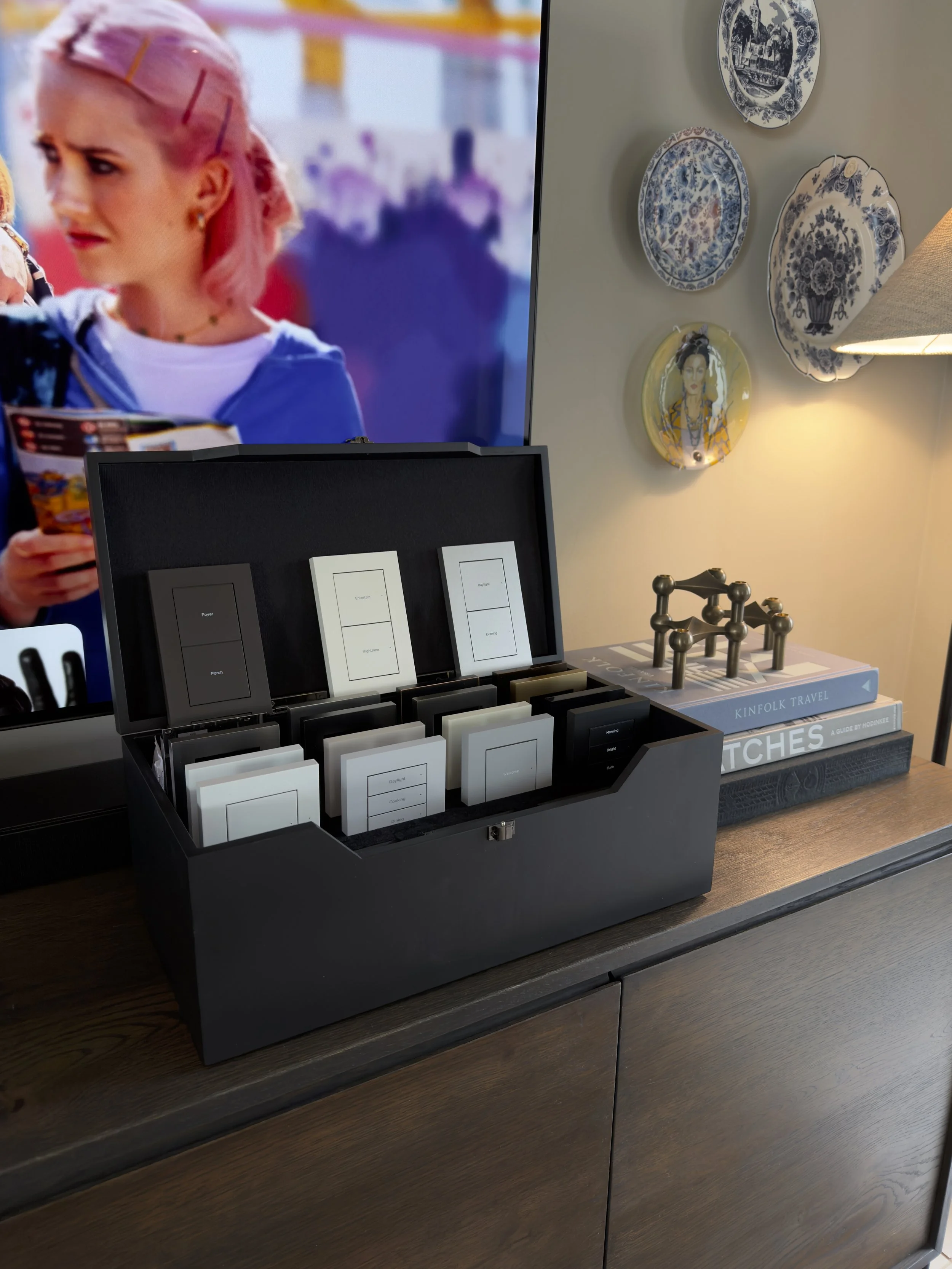
Automated lighting control solves a design problem before it solves a technology one. One elegant keypad with four scenes. Human centric lighting that shifts colour temperature through the day, so the house is warm at 8pm and clean and bright at 8am. And, at the end of the evening, one button that shuts down 800m² of house instead of a fifteen-minute walk.
More of these homes belong to people who are not standing in them
This is the change we have watched accelerate most sharply, and it does not get discussed enough.
Data analytics firm Lightstone found that 39% of all R20m-plus sales in the ten years to end-2025 went to international buyers, including foreign-born South African citizens. In the R10m to R20m band nationally, foreigners accounted for 26% of transactions. In Llandudno, two of every three properties sold over the past decade went to a foreign buyer. Cape Town absorbed R153bn of foreign property purchases over that decade, against Joburg’s R107bn.
A meaningful share of the most expensive housing stock in this country now stands empty for eight to ten months of the year.
An empty luxury home is not a passive object. It is a set of running risks. A geyser fails in July and nobody notices until the ceiling comes down. A borehole pump runs dry and burns out. The garden dies because the irrigation controller lost its schedule after a power dip. A contractor needs access on a Tuesday and the owner is in Zurich.
For that owner, automation is not a lifestyle purchase. It is custodianship. Remote visibility of every camera, leak detection at the manifold, temperature and humidity monitoring in the wine cellar, occupancy simulation that varies lighting and blinds convincingly rather than switching the lounge on at 7pm every night like a tell-tale, and time-limited access codes so the housekeeper or the pool service can get in without keys being couriered around the peninsula.
We increasingly design for the months the owner is absent, not the weeks they are present. That reversal would have seemed strange five years ago.
What the market has started treating as a defect
The Cape Town luxury market is supply-constrained and competitive. Seeff reported 115 sales above R20m in Cape Town in the first half of 2026 alone, 13 of them above R50m, against a record 190 for all of 2025 and just 49 in 2019. Pam Golding describes severe stock shortages and competitive bidding in the R20m to R70m bracket.
In a market that tight, buyers at this level arrive with a list. Integrated app-controlled security. Energy monitoring. Automated lighting and climate. They are not asking whether the house has it. They are checking.
The absence of it becomes a negotiating lever, and a fair one, because retrofitting a house that was never wired for it is genuinely disruptive and genuinely expensive. Chasing walls in a finished home in Camps Bay is not a weekend job.
There is a smaller financial argument too. A certified alarm system linked to a monitoring control room typically reduces household contents premiums by 10% to 15% with South African insurers, and a properly documented, maintained installation with a valid compliance certificate strengthens your position when a claim is actually made.
Where these projects go wrong
We should be honest about this, because plenty of expensive systems in this country are unloved and half-abandoned.
Automation fails when it is bought as a pile of products instead of designed as a system. Someone buys a smart doorbell, a different brand of thermostat, a third-party alarm and a set of app-controlled globes, and ends up with six apps, four accounts and a house nobody but the owner can operate. The wife hates it. The housekeeper will not touch it. The teenager has worked out how to bypass it.
It also fails when it arrives too late. The single largest determinant of what a smart home will cost, and what it will be capable of in fifteen years, is the cabling installed at first fix, before the plaster goes on. Cable is cheap while the walls are open and ruinous afterwards. Touchscreens, processors and apps will all be replaced twice over the life of the house. The infrastructure behind the wall will not be. Get that right and everything else stays upgradeable.
And it fails when it is complicated. The test we apply is simple: can a guest who arrived an hour ago turn on a light without being taught? If not, the design is wrong, no matter how impressive the specification sheet reads.
The short version
Load shedding is over, and smart home automation in South Africa’s premium market is growing anyway. That is the whole tell. The blackouts were a symptom that briefly made the case obvious. The underlying reasons — an electricity tariff climbing near 9% a year, houses too large and too architecturally open to control by hand, owners who are frequently on another continent, and a resale market that now expects it — were always the real ones, and none of them are going away.
If you are building or substantially renovating above R10 million in Cape Town or the Winelands, the decision worth making early is not which system to buy. It is getting the design and the cabling right while the walls are still open.
SIAV has designed and installed smart home automation, lighting control, security, AV and energy systems across Cape Town and the Western Cape since 2008. See our project gallery, explore our services, or start a system design. To discuss a project, get in touch.
Frequently asked questions
Does smart home automation add value to a property in South Africa?
In the R10m-plus bracket it increasingly protects value rather than adding a premium. Buyers at this level treat integrated security, energy management and lighting control as expected specification. A well-documented, professionally installed system removes an objection during negotiation; its absence gives buyers a reason to discount, because retrofitting a finished home is disruptive and costly.
Is home automation still worth it now that load shedding has ended?
Yes, for different reasons. Backup power was only ever one function. With Eskom tariffs rising 8.76% to 9.01% in 2026 and a further 8.83% approved for 2027/28, the value has shifted to load management: running high-draw equipment like pool pumps, heat pumps and underfloor heating against solar generation and off-peak periods rather than against expensive grid supply.
What does smart home automation cost in a luxury home in Cape Town?
It scales with the size of the house and the scope of the system, so a meaningful figure only comes out of a design conversation. What matters more is timing. Specifying at first fix, while walls are open, costs a fraction of retrofitting the same capability later, and produces a far better result.
Can an existing home be automated without major building work?
Often, yes. Wireless and hybrid lighting control, network upgrades, security integration and energy monitoring can all be added to an occupied home with limited disruption. Full-scale automation of climate, blinds and multi-room audio is significantly easier during a renovation, when ceilings and walls are already open.
Which systems should be automated first?
Start with the network. Reliable, well-distributed Wi-Fi and structured cabling is the foundation everything else depends on, and the most common cause of systems that feel unreliable. After that, lighting control in the main living areas and energy management typically deliver the most noticeable daily difference.